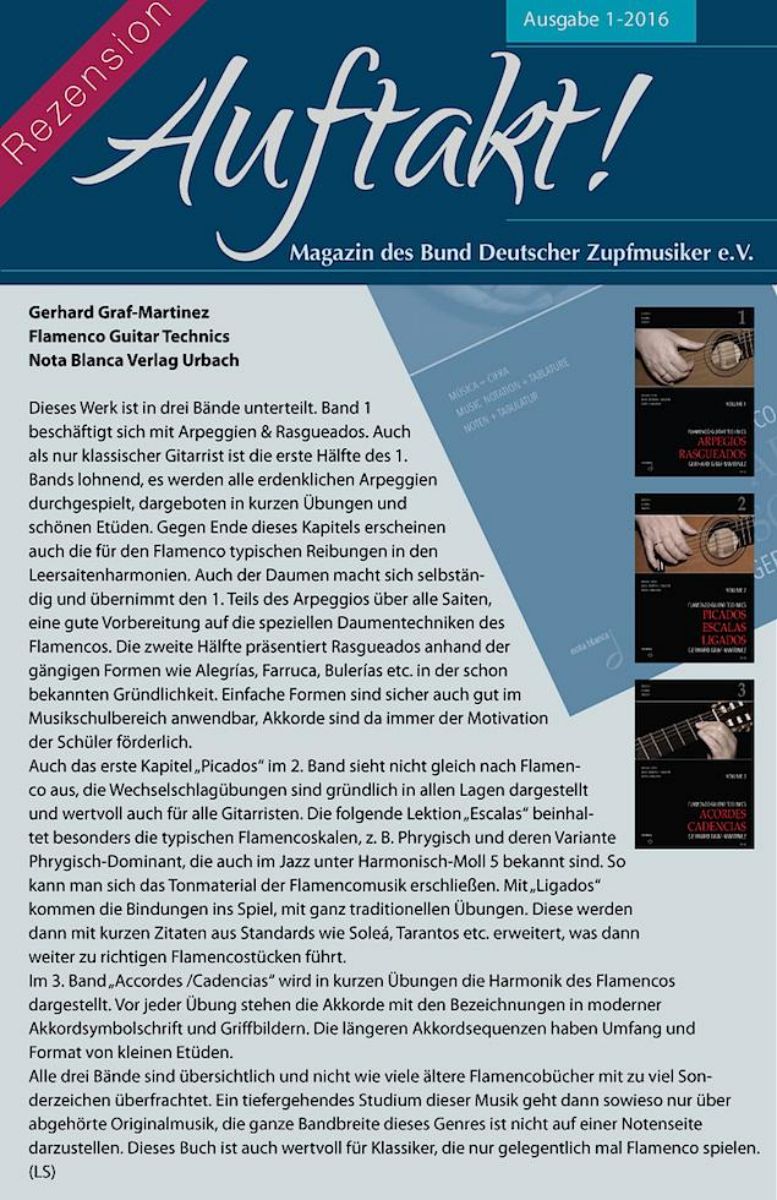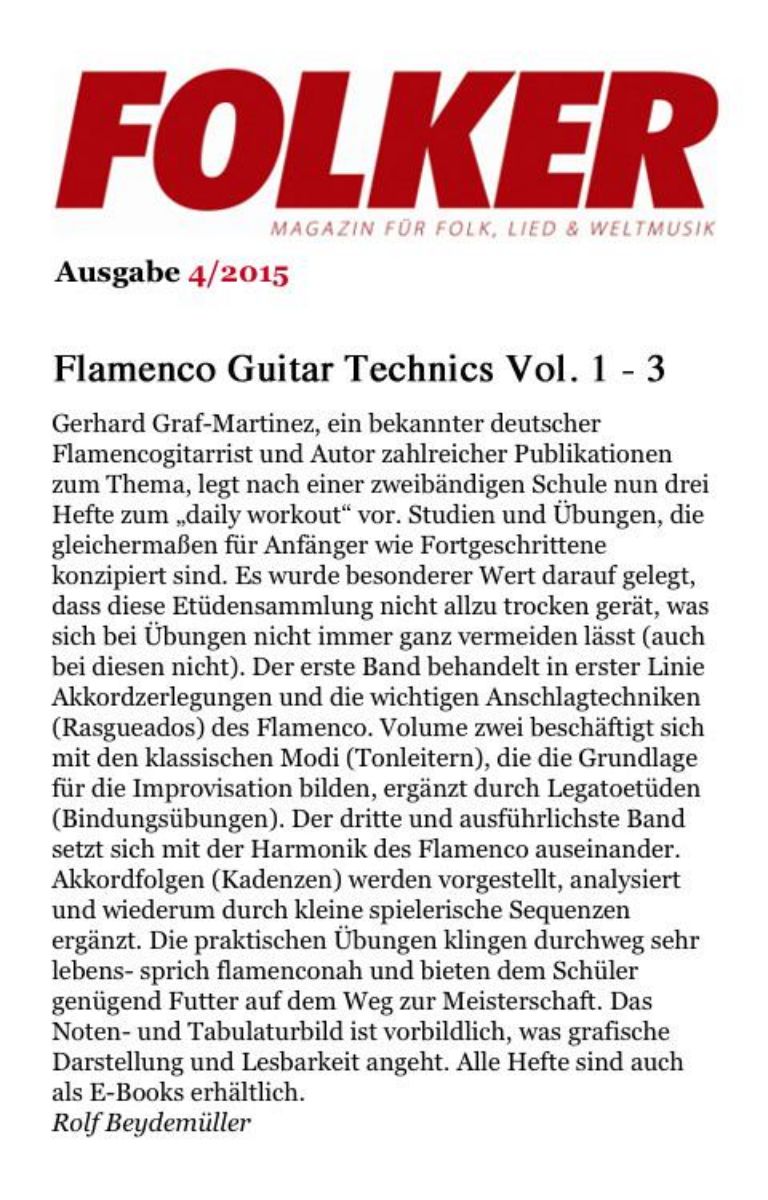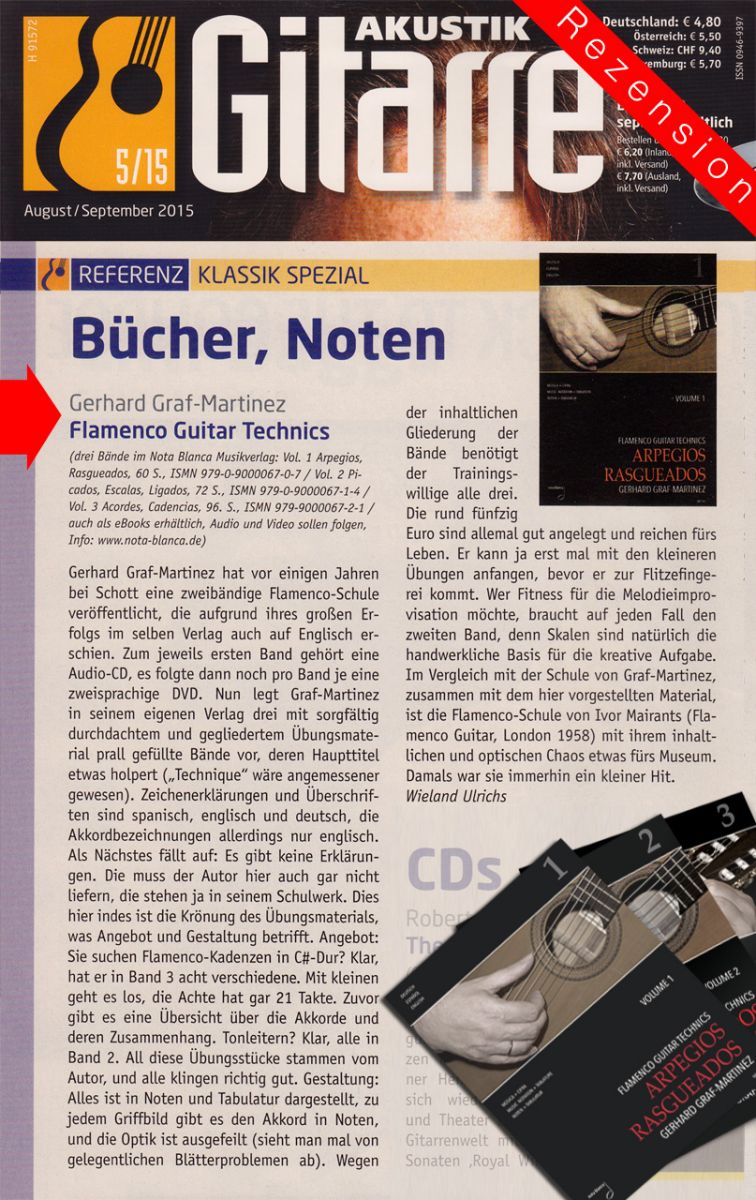
Flamenco Guitar Technics
Vol 1 - 3
These 3 volumes are about the techniques of the left and especially the right hand in flamenco guitar playing. These are not textbooks, but etudes and studies for daily practice. With these exercises all the techniques found in flamenco guitar are trained. All exercises can be used as warm-ups or daily exercises. Technique does not have to be dry, meaning that great emphasis has been placed on sound and authenticity in all of the etudes, which means that the practical examples encourage practice and are fun to play.
The three volumes are available as a “classical“ music book, as well as an iBook.
Flamenco Guitar Technics Vol. 1: Arpegios - Rasgueados
eBook version - Apple iBook
NB 141
ISMN 979-0-9000067-0-7
iBook: iBNB 141
Deutsch | Español | English
Sheet music and rhythmized tablature - 61 pages
Contenido | Contents | Inhalt
Explicación de los signos | Explanation of Symbols | Zeichenerklärung
Arpegios, Estudio 1 - 13 , Rasgueados
Muñeca | Wrist | Handgelenk
Verdiales, Fandango de Huelva
Tressillos | Triplets | Triolen
Farruca, Soleá, Alegrías, Bulerías en La, Bulerías en Mi, Soleá II
Rasgueados Dedos | Fingers | Finger
Tangos Verdiales II, Fandango de Huelva II
Tresillos | Triplets | Triolen
Alegrías II, Alegrías III, Farruca II, Bulerías, Bulerías I - III, Soleá III, Soleá IV, Siguiriyas
Flamenco Guitar Technics Vol. 2: Picados - Escalas - Ligados
eBook version - Apple iBook
NB 142
ISMN 979-0-9000067-1-4
iBook: iBNB 142
Deutsch | Español | English
Sheet music and rhythmized tablature - 72 pages
Contenido | Contents | Inhalt
Explicación de los signos | Explanation of Symbols | Zeichenerklärung
Picados
Modo Dórico | Flamenco Mode | Flamenco-Modus
Escalas | Scales | Tonleitern
Mi Dórico | E Dórico, La Dórico | A Dórico, Si Dórico | B Dórico | H-Dórico,
Fa# Dórico | F#, Dórico Sol# Dórico | G# Dórico, Do# Dórico | C# Dórico,
Do Mayor | C Major | C-Dur, Re Mayor | D Major | D-Dur,
La Mayor | A Major | A-Dur, Mi Mayor | E Major | E-Dur
Ligados Legato Bindungen
Ligados Estudios | Legatos Studies | Bindungsübungen
Flamenco Guitar Technics Vol. 3: Acordes - Cadencias
eBook version - Apple iBook
NB 143
ISMN 979-0-9000067-2-1
iBook: iBNB 141
Deutsch | Español | English
Sheet music and rhythmized tablature - 96 pages
Contenido | Contents | Inhalt
Explicación de los signos | Explanation of Symbols | Zeichenerklärung
Acordes Cadencias
Mi | E Cadencias en Mi | Cadences in E | Kadenzen in E,
Cadencias en La | Cadences in A | Kadenzen in A,
Cadencias en Si | Cadences in B | Kadenzen in H
Cadencias en Fa# | Cadences in F# | Kadenzen in F#
Cadencias en Sol# | Cadences in G# | Kadenzen in G#
Cadencias en Do# | Cadences in C# | Kadenzen in C#
Cadencias en Mi Mayor| Cadences in E Major | Kadenzen in E-Dur
Cadencias en La Mayor | Cadences in A Major | Kadenzen in A-Dur
Cadencias en Do Mayor | Cadences in C Major | Kadenzen in C-Dur
Cadencias en Re Mayor | Cadences in D Major | Kadenzen in D-Dur
In 51 iBook-Stores:
Argentina, Australia, Austria,Belgium, Bolivia, Brazil, Bulgaria, Canada, Chile,Colombia, Costa Rica, Cyprus, Czech Republic, Denmark, Dominican Republic, Ecuador, El Salvador, Estonia, Finland, France, Germany, Greece, Guatemala, Honduras, Hungary, Ireland, Italy, Japan, Latvia, Lithuania, Luxembourg, Malta, Mexico, Netherlands, New Zealand, Nicaragu, Norway, Panama, Paraguay, Peru, Poland, Portugal, Romania, Slovakia, Slovenia, Spain, Sweden, Switzerland, United Kingdom, United States, Venezuela
Flamenco Guitar Techniques
This is not a free online course on flamenco guitar or a series of free lessons, but rather a list of techniques that differ from other guitar techniques or are unique to flamenco guitar playing. The links lead to preview videos of my DVDs *Flamenco Guitar Vol. 1 + 2* on YouTube.
The publications, as well as free flamenco lessons, can be found here.
The following videos are taken from the English edition. In the German edition, the videos are also in German.
Rasgueado
is the most commonly—whether due to a lack of knowledge, half-baked information, or sheer ignorance—incorrectly executed flamenco guitar technique and, in these cases, can justifiably be described as rattling, strumming, or scraping the strings. The numerous types of rasgueado cannot be learned with just a single trick. It is rather a lengthy process until it sounds crisp and sparkling.
Pulgar
The thumb (Spanish: pulgar) is still used extensively today in modern toque (Flamenco guitar playing). With a few exceptions, it is always played apoyando, that is, with the thumb resting on the fretboard.
Golpe
“Golpe” refers to all strikes on the body of the guitar—more specifically, on the soundboard and/or the fretboard. These strikes are performed with the palm, the thumb, or the middle finger. Most commonly—or rather, as the term implies—the “golpe” is executed beneath the strings using the ring finger.
Tresillos
“Tresillos” refers to anything that occurs in a movement of three. However, this does not necessarily mean that they are triplets.
Arpegio
In the arpegio [pronounced: arbe(c)hio] of the flamenco guitar, unlike the arpeggio [pronounced: arbetscho] of the classical guitar, the thumb (p) is always placed on the string—that is, played apoyando—provided the adjacent string allows it.
Tremolo
In the flamenco tremolo, five notes—a quintol—are played instead of four 16ths or 32ths. However, many other patterns can also be heard. More importantly, unlike the classical tremolo, the thumb is placed on the string.
Picado
Picado refers to the alternating plucking between the index finger (i) and the middle finger (m). “Picar” means to pluck or prick, and it differs from the so-called alternating stroke in classical guitar in that the strings are struck with the thumb placed against the guitar and the middle joint bent toward the guitar’s soundboard. Of course, the base joint also moves along with this, but under no circumstances should the middle joint be straightened; rather, it should be bent quite sharply.
Alzapúa
This strumming technique is used exclusively in flamenco. “Alzar” means to lift or pull up, and “púa” is the pick. This means the thumb is used like a pick. The best-known form is the one played across three strings. However, the variation played across one or two strings is also frequently heard.
Bulerías
Rhythmic analysis of the bulerías, as well as alternative counting methods.
The left hand
As far as the left hand is concerned, there is no difference from other guitar styles. It’s worth noting that two strings are often played with a half-barré, that is, with one finger. For example, in the A major chord, the E on the 4th fret and the A on the 3rd fret are played with the index finger. Or in the C/G chord, the G on the 6th fret and the C on the 5th fret are played with the ring finger.
Difference from the Classical Guitar
The playing style of the classical or concert guitar differs not only in the techniques mentioned above but also in tone production. For a long time, it was assumed that the sound was produced primarily by the guitar itself. But even when a flamenco guitarist plays a concert guitar with a trained strumming technique, it still sounds like “flamenco.” The reverse is also true—a flamenco guitar in the hands of a classical guitarist generally does not sound like flamenco. I have never heard a professional flamenco guitarist play a classical piece in public. Concert guitarists, on the other hand, have never had a problem playing “a flamenco piece,” at least as an encore. Presumably, it has to do with disrespect or arrogance—in an age of specialization, to believe that one can play anything with a technique that stands above all others. Classical guitarists have my utmost respect—I myself was trained on the concert guitar—but now, decades later, I believe that classical technique hindered me more than it helped me. Furthermore, I’m firmly convinced that, beyond a certain level, the two techniques are no longer compatible. Not to mention phrasing and articulation.
More Videos
Soundlice: Video synchronized with notation/tablature · See exactly what’s being played · Hear exactly how it’s played · Never lose your place · Everything is always in sync · Slow down without changing the pitch · Fretboard and keyboard views for visual learners.
Gipsy Guitar - Rumba flamenca - DVD accompanying the sheet music album of the same name - de/en
Flamenco Metronome - Software for Mac/Win
Flamenco Percusión - Software instrument/templates for Logic and GarageBand
Reloj Flamenco - the next generation of the Flamenco Metronome
Lessons
Site Owner
Gerhard Graf-Martinez
Theodor-Baeuerle-Weg 9
73660 Urbach
Fon +49 (0)7181 480 90 25
Imprint | Privacy policy
© Copyright 1995 - 2026 · Gerhard Graf-Martinez